I want to plant something!

January 10th……I want to plant something!

Here it is, not even mid-winter and the urge has hit me.  Why?  It’s not as if I don’t have anything growing right now.  The Christmas Paperwhite Narcissus are in full bloom through out the house.  I kind of over bought on those bulbs.  They were so big and beautiful.  I got them started in my cold house as soon as I bought them.  Some went in soil and others in cache pots with gravel and water.  The result was lovely but too much for my small house, so 4 pots went to friends and neighbors.

paperwhitesbulbs


The The Amaryllis are poking along.  I ordered them late and tried some dwarfs this year.  So far they are disappointing but I’m willing to wait.  Out on the back porch, 3 pots of tulips are well rooted and properly cooled.  They’ll begin growing as soon as I bring them into the warmth of the house.  I expect spectacular reds and purples to brighten the late February days.

Going back to my question.  Why this urge to plant?  I blame it on the temperature.  I live in outer SE Portland, so the big blow of early January put us in hibernation mode.  When the temperature jumped up to 53 degrees, my inner gardener woke up with a start.

emerging bulbdWhat to plant?  I have 3 empty pots on my front porch looking drab and forlorn.  I could fill them with violas or primula.  These plants need weekly feeding to keep them blooming.  Am I willing to do that all winter and spring? Probably not.

My vision was something vigorous and evergreen that I could enjoy out my window.  I decided that a cedar hanging box full of ivy would do it. It might also entice spring robins to nest later on.  Now before you start typing a reply about invasiveness, rest assured, the plants will never touch the ground.  In fact, the plants I’ll use will come out of my yard where they have escaped the constant rouging out process.

ivy

I’ll start the planter under my grow lights indoors to speed things up.  The plants will not go full blast until spring really sets in, but they’ll have a head start, and my primal planting urge will be under control….for a little while.

Here are some hints for winter planting. 

1) Be realistic; ask yourself what you have already available in containers and plants; how much work do you really want to do? 

2)  Cast your net wide; try something you’ve never tried before, like lettuce or herb seeds, forcing bulbs, or blooming indoor plants ( try African violets or Cape primroses– Streptocarpus, Begonias are also satisfying to grow at this time of year. 

3)  Use fresh potting soil and some time release fertilizer, don’t over water. 

4)  If you can, start out door plants inside or at least in a cold frame.  Bottom heat will make them root faster. 

5)  Be patient; out door plants especially will be slow during cold weather.

  6)  If you can’t be patient, shop for instant gratification.  Many garden centers have stocked lush house plants and vigorous out door plants just to satisfy your planting urge. 

ENJOY! And take heart, planting time will be here soon.

Nadine

Gallery

Would you eat this fruit?

This gallery contains 4 photos.

During the summer of 2010 we were surprised to find that our specimen Decaisnea fargesii had come into bloom for the first time in its ten year history in our garden. We had planted this large deciduous shrub with dreams … Continue reading

EASY-CARE BLUESTARS

Some gardeners are afraid of large herbaceous perennials because they leave gaping holes when they go dormant in the winter.  In the maritime climate of the Pacific Northwest where we are blessed with relatively mild weather and can easily achieve an all-but evergreen garden, this is perhaps a relevant complaint.

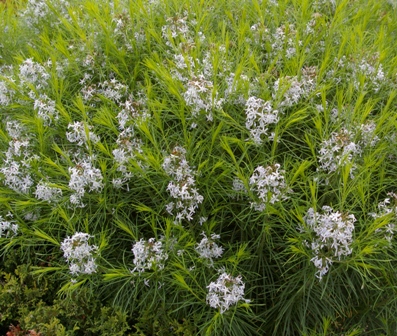
That said, there is still the sheer thrill of growing herbaceous perennials for the sense of seasonal change they give us.  Among the very easiest of underused and very hardy herbaceous perennials are the Bluestars, genus Amsonia.    At Joy Creek Nursery, we have been growing these delightful, billowing plants for almost twenty years.   The tongue-tying species Amsonia tabernaemontana var. salicifolia was our introduction to the genus.  (By the way, A. tabernaemontana is commonly calledWillow bluestar and it is odd that the varietal name also means “willow-like foliage.”  Perhaps this is simply to amplify our understanding of its appearance.)  From there we graduated to A. illustris and later to A. cilliata and A. hubrechtii.  Along the way we tried to grow the dry-land species Amsonia peblesii from seed but did not have much luck.  We have only grown the North American species although there are species from Asia, Europe and theMiddle East as well.

Amsonia huprectii

These are not plants like lilies that announce their arrival with large blaring trumpets.  They are much subtler than that.  Their stems emerge in early spring from well-developed clumps much as those of milkweeds do.  (In fact, the common name for one species is blue milkweed.)     Instead of trumpets, the willowy, upright stems bear constellations of small soft blue stars in panicles at their tips.  The blooms arrive in late spring or early summer depending on the species.  During the course of the summer, the fertilized flowers form numerous long, narrow, papery seed pods that are also of interest.

The foliage and height of these various species is what makes them distinct from one another.   A. tabernaemontana has fairly broad leaves that are up to three inches long.  In our garden, it stands four feet tall or better.  A. Illustris is also in the four foot range with similar lance-shaped leaves.  A. ciliata (called the Blue milkweed) has much narrower leaves and it ascends to three feet or more.  (There is a selection from this species called ‘Halfway toArkansas’ that is much shorter than the species and has slightly broader foliage.)  Of all of the forms we grow, A. hubrechtii, from the central to the northeast part of the States, has the most feathery foliage.  This plant only gets to about three feet.

All of these species have lovely fall color.  The more sun they get, the more pronounced their transformations.  Generally, their leaves turn yellow, but in A. tabernaemontana, A. illustris, and even somewhat in A. ciliata, there is also bronze and a little purple in the mix.  A. hubrechtii seems to turn uniformly golden in our garden.

Amsonia ‘Halfway to Arkansas Fall Color

Amsonia do not ask much more than average summer water.  Over time our specimens have become somewhat drought tolerant.  Further, we have never had to down-size our plants although it did take several years for them to develop into generous clumps.  We use them in the background and as specimen plants.  Their stems move gracefully in the wind.  Their flowers are attractive to pollinators and birds and they offer us a sense of the changing season from spring green through delicate bloom and brilliant autumn coloration to winter dormancy.

Maurice

Red Pig Garden Tools

We are excited to have Bob Denman, owner of Red Pig Garden Tools, as our speaker this Sunday (June 10th).  His talk is titled ”Price Is Not The Only Difference” where he will go into depth about how tools are made and how to tell the difference in quality.  Maurice was able to convince him to bring a few tools to sell as well.  I am looking forward to it and hope that we get a few people to come out.

Bob at the Forge

This winter I decided that I wanted a trowel for Christmas.  I looked at all the tools available online and had settled on something made in Holland that was going to cost quite a bit.  I was ok with this but then I came across this tool company that made handcrafted tools and was located fairly close in Boring, Oregon.

My wife and I drove out on a Saturday in November and wound our way out into the countryside.  We pulled up to a barn, which I found out is actually constructed out of two old barns, and rung a bell to let them know we were there.  We were first greeted by a friendly dog and then Bob showed up.  The store is packed full of all kinds of garden tools from huge warrior ax looking things to small Japanese propagation scissors.  We looked around for a bit and I picked up nearly every tool in the place to look at.

Eventually I got to chatting with Bob  and told him what I was looking for.  The conversation turned in many directions and he covered the history of garden tools for the last 150 years, how each tool is made and the materials that go into them (many are made out of old sawmill blades), the different methods of weeding depending on the planting environment, and on and on it went.  We talked for around two hours and I felt thoroughly enlightened on the subject of garden tools.

I didn’t buy the trowel I had drove out for, there is one I am building in my head that I will probably have him custom make, but I did not leave empty handed.  I bought the Cape Cod Weeder and have loved using it this spring.  It looks like a crazy sharpened hook and really takes out weeds.  More importantly I got a file to sharpen all my tools.  Having well maintained tools has made me enjoy gardening even more.

I hope you can make it out for the class on Sunday, but if not I would definitely check out  Red Pig Garden Tools.

Andy

Adventures in Hiring a Gardener

Well, I finally did it. I called for help in my garden. The weeds
finally pushed me over the edge. It is a relief to have made the
decision . So this is how my process went.

My garden is on a large city lot and is complicated. There is a lot
to be done, so I had to prioritize my needs before I called anyone.
As I said earlier, the weeds are my priority. I determined that what
I would ask my would-be gardener to do was weed (most of it by hand)
and spread mulch. I didn’t decide until during the interviews whether
I wanted the bids with mulch delivered or whether I would arrange for
the mulch delivery. I realized that a lot of this process is about
control.

A Garden in Need of Help

When I shop for services like this, I always shop in 3′s. I had been
collecting fliers for years from landscapers who had either put them
in the paper or my door. I picked three that listed the services I
needed and called each one for an appointment. #1 wanted to have an
hour spread during which he would show up. (It turned out at the
latest time.) Numbers 2 and 3 made a specific time commitment.

#1) Showed up with his book and was raring to go. As we walked
around the garden I realized he was not listening to me and was
wrapped up in assessing the property according to what he wanted to do
with it. He even wanted to relocate my blueberries so that he could
put Caseron in the bed! Needless to say, I DON’T DO CASERON. After
10 minutes, he handed me my bid and left.

#2) Showed up promptly. I showed him some of my trouble spots ie: a
clematis that I have growing on the ground with weeds growing up
through it. He understood that there were complications like that all
over. He was very enthusiastic but in a different way from #1. He
was interested in my plants! He was also interested in the way I did
things and why. After 30 minutes he gave me my bid. I really liked
him.

#3) Was a young man with a brief case full of receipts. He seemed
tired. He wanted to put down a large amount of mulch. I could tell
he had done this many times before and he knew what he was talking
about. He said he ran 2 crews in the Portland/Vancouver area. He
gave me his estimate after about 20 minutes.

The first estimate I got took my breath away! Even including the
delivery of the mulch, it seemed extremely high. The amount was about
4 times the amount I budgeted. The other 2 estimates were much more
in my ball-park. One with mulch and the other without. The second 2
offered either payment plans or senior discounts, and one said if you
don’t like my work, you don’t have to pay me.

You might have deduced by this time that I chose to hire #2. He was
competent, interested and he just struck a chord with me. I took 3
references from the last 2 people but confess that I did not contact
them. When I called to tell him, he was very grateful. He will be
doing the job in a couple of weeks. That is when we shall see if my
instincts were right.

So, some tips: Know what you want and stick to it; Talk to neighbors
or friends for their experiences and references; Contact the local
high school or community college if they have a horticulture program
keep meticulous records of all contacts; Be sure to have a number of
contacts and Do let your instincts instruct you. I’ll let you know
the results in a few weeks. Thanks to the members of my Aging in the
Garden class for many of the suggestions.

Nadine Black

I have to add that Joy Creek has a wonderful maintenance crew.  Nadine didn’t consider them, but I feel like I will get in trouble if I don’t mention it. 

Using Gravel to Improve Your Lawn

For being a nursery that specializes in clematis, hydrangeas, fuchsias, and perennials, we sure talk a lot about gravel.  We use it in our pathways, use it to amend our planting beds, and use it as mulch.  But what we get asked about most is how we use it on our lawn.  When we last treated the lawn at the nursery I did a five month pictorial to show people how this works.

It is best to do this treatment during the rainy seasons.  So usually  October through  April  are your best times for gravel application  If you will be doing compost and overseeding,  October, March and April and sometimes May, are the best times.  If the existing lawn is very sparse or has existing bare spots compost and overseeding is reccomended.

First mow your lawn short and aerate if you want.

January 11

Here is the lawn on January 11, one week after the gravel had been applied. About 3/4 of an inch of quarter ten gravel was spread over the top of the existing lawn.  The type of gravel is important.  1/4 10 is crushed basalt that has been washed. Having gravel that is crushed, not round, allows it to travel better through the soil and help improve drainage.  You want the washed variety because you do not want to be adding sand to clay soil.  We added extra gravel to fill in a low area that is on the far left of the picture.

February 1

After a few weeks, on February 1 you can see the lawn starting to grow through the gravel. In the last ten years there has been roughly four inches total of gravel applied to this lawn.

March 4

Due to a warm February, some of the grass has started to grow by March 4, but there are still gravel patches. We apply the gravel for two main reasons. First, it helps with winter drainage so that the lawn does not get mushy and mossy with all of our rain. Second, by breaking up the soil underneath the lawn it lets the grasse’s roots travel deeper whcih in turn allows you to water less in the summer.

March 25

This is a high traffic lawn and certain areas needed extra care. We top dressed them with some organic compost and re-seeded the bare spots.

April 29

By April 29 it was staring to look like a normal lawn again. At no time was this lawn blocked off, and since it is in the middle of one of the main garden paths, it was being walked on daily by a number of people

May 15

On May 15 it is hard to tell if the gravel has even been applied. This lawn takes a beating all summer, thousands of people walk across it, and is watered deeply maybe once every two weeks and still manages to stay green.

Andy

Clematis ‘Asao’ and Clematis ‘Kakio’ (PINK CHAMPAGNE)

Over the decades, I have enjoyed watching the ups and downs of clematis cultivars on the international best-seller list and, on a more modest scale, at our nursery, Joy Creek Nursery.  With so many new cultivars being released annually to distract the public, I am always amazed that the tried and true names like ‘Nelly Moser’, ‘Henryi’ and ‘Jackmanii’ continue to hold a fair share of the market even though in human years they are well past retirement.

Clematis 'Kakio'

It was with great surprise last year that a plant that had been on the market for at least 20 years in the United States suddenly became a nursery best-seller.  Out of the blue, one day, we began to receive orders from customers who had read an article in Garden Gate magazine about Clematis PINK CHAMPAGNE, originally named ‘Kakio’.  The orders came in briskly and surpassed the orders of all other clematis in our catalogue last spring.  What was most surprising was that Clematis ‘Asao’, the sister of PINK CHAMPAGNE and usually a better seller, did not sell well at all.

Both plants are the results of a cross done by the Japanese hybridizer Kazushige Ozawa between (what we think was) Clematis ‘Ernest Markham’ and Clematis ‘Crimson King’.  There were three seedlings that were released from this cross but only the two sisters remain.  ‘Asao’ and ‘Kakio’ are very similar in appearance with bright rose red flowers in April.  As the flowers of both cultivars age, they become lighter at the bases and centers of their sepals.  ‘Asao’ is usually the first of all our large-flowered clematis to bloom at the nursery in the spring followed soon after by ‘Kakio’.  (By the way, the names refer to actual small towns in Kawasaki near the hybridizer’s home.  Raymond Evison, the well-known English hybridizer and nurseryman, visited Japan in 1984 and received ‘Kakio’ from Mr. Ozawa.  He renamed it PINK CHAMPAGNE for marketing purposes.)   It is interesting that even though the two plants are close in appearance, Mr. Ozawa chose to release both instead of choosing one over the other.  Why is that?

Clematis 'Asao'

I think it is because he had come to love both of them and thought they were different enough in character to warrant release.  ‘Asao’ is the more star-shaped of the two.  She is also the flashiest in appearance with flowers that show extra sepals.  Sometimes this results in flowers that are semi-double or even completely double.  ‘Kakio’ has what appears to me to be an underlayment of lavender on its more rounded sepals.  This underlayment gives the flowers a smoky appearance.  I have never seen ‘Kakio’ double.  Neither sister produces much fall bloom although they sometimes manage a lovely stray flower or two.  It is the stunning spring bloom that is so memorable.  It is long and unforgettable enough to make a gardener anxious for spring to see the familiar flowers again.

Over the years Mr. Ozawa gave up growing and selling both plants.  He said that the temperature index in the Tokyo area had gone up so much since the plants were released that they no longer retained their crisp colors when they bloomed.  He told me that both were more suited to areas with cooler spring temperatures.  I remember a visit he made to our nursery when ‘Asao’ was in bloom.  He was delighted to see the flowers looking the way he remembered.

I have no idea what clematis will become the most sought after this coming year.  But if you want one or two reliable and remarkably beautiful spring flowering clematis, either or both of these “new” classics will do.

Maurice Horn

Class Preview: Low Water Gardening with Maurice Horn

We continue our class series this weekend with Maurice’s talk on low water gardening.  Maurice is co-owner of Joy Creek Nursery and has years of experience with low and no water gardens.  He has worked on large scale projects with Reed College and the Oregon Department of Transportation as well as smaller projects here at the nursery and at clients homes.   The class is Sunday, April 8th, at 1pm.  No registration or fee required.

Near the end of a rainy day I sat down with Maurice and asked him a few questions.  The conversation went a little long because this is a topic that Maurice is both passionate and knowledgeable.  This is a slightly condensed portrayal of what we talked about.  You are just going to have to come out to the class to find out more.

Clematis 'Durandii'

What is your inspiration for this class?

I want to help people lower their water usage. The commercial and residential projects I have worked on have taught me quite a few ways to do this.

Do you have a goal for the students?

I want to increase their familiarity with soil amendments and appropriate plants so they can be successful with this at their home.  There are also a series of tips and lessons that I have learned through experience.

Such as?

For hell strips, a planting strip between street and sidewalk, there is a certain logic that you have to follow.  You have height restrictions because you cannot block any views and this is also a heavily used area where trash cans have to go.  Within this framework there is a plant pallet and design that work.

Bulbs are also great no water plants that can give you bloom throughout the season.  This is not just tulips and daffodils, but a wide array of underused varieties that thrive in this situation.

You have a hell strip at your house, what plants have you enjoyed most in it?

In my own garden I am allowed to experiment more.  Clematis ‘Durandii’ has been a wonderful surprise.  It is the only clematis that I have grown that has bloomed well without supplemental water.  I also have a wide variety of bulbs that are nearly always blooming.  They really add to the garden.

I would like to thank Maurice for sharing his time.  We hope you can make it out to the class to learn more.

Class Preview: “Fundamentals” with Leslie Gover

Our weekly classes get into full swing starting with Leslie Gover’s talk on gardening fundamentals.  It is a broad topic but Leslie will breathe some life into the important and often overlooked parts of gardening.  Soil, water, nutrition, and planting will all be discussed in an effort to get you a heather and more happier garden.  The class is on Sunday April 1st at 1 pm, no registration required.

Putting the fun in fundamentals

“Fundamentals” is a broad ranging term, what particular aspects of gardening are you going to look at during the class?

Gardening has changed.  This is what we will discuss, what used to be cookbook is much different and our amount of plant material and where it originated from is as equally different.  This is not your grandmothers garden plan.

When you talk about nutrition what are you referring to?

I teach a seed sowing class for kindergarteners and we talk about the nutrition aspect.  French fries and pizza has come up a few times.  But we will talk more about what the causes the fertilizer to be used.  A bit more indepth than my kindergartners.

What are factors that lead to it being the right time to plant?

I think that we have all been in that situation where the plant we bought is put in the ground and it slowly loses vigor and turns to mush.  (Surely this is not my fault……!!!!!!)  But what do we do.  Can we trouble shoot this ahead of time.  We will look at this senerio and others.

How do plants talk to you, and what are they saying?

Part of the “talking” is the response of the plant to the soil and enviornment.  So lets listen to what the plants are saying and doing to get the right fit for both the plant and gardener to be sucessful.

It won’t be very warm and it probably will be raining for the class so remember to dress warm and dry.  There will be a canopy but rain has a habit of going sideways sometimes.  Leslie promises to be concise and keep it interesting.  We hope to see a few brave people on Sunday.

Full Circle: Cistus and Halimium Survival Stories

Recently, I was asked to design a border for a narrow bed fronting the largest solar power array in the State of Oregon.    The array is situated in the interior of the Baldock Rest Stop just north of Aurora on I-5 going north.  The site is four hundred feet long and four feet wide and is surrounded by fencing on all sides.  In addition, the site has no ready access to water.   All of the plants selected must be drought tolerant.  As I began to envision this unusual site, one of the first shrubs that came to mind was Cistus.

Baldock Planting Area

We have long been familiar with a number of species and cultivars of Cistus at Joy Creek Nursery.  In 2005, however, we were very pleased to learn that Oregon State University was trialing a large collection of Cistus and the allied genus Halimium at the North Willamette Research and Extension Center near Aurora, Oregon.  This gave us the opportunity to observe new and unfamiliar plants all in one place.  Both of these genera are native to the Mediterranean areas of Europe and North Africa and have long been used in gardens in parts of California with an allied climate.  They have been much less common in Northwest gardens.

In 2006, the Research Center offered to share cuttings with our nursery.  Of course, we were thrilled.  This began our own trials of Cistus and Halimium in what we call our no-water border.  Our trials involved not only cold hardiness, but also drought tolerance.

Cistus 'Ann Palmer'

The winter of 2009 was one of the cruelest in recent memory.  At the nursery, cold temperatures plummeted to just above 10°F in mid-December and snow fell most of the last two weeks of that month.  The effect of sudden cold after a mild autumn was bad enough, but the accumulation of snow also did great damage, breaking off branches and even snapping entire plants off at their crowns.  It became obvious to us that the weight of wet snow is a problem for many of the evergreen Cistus.

In the spring we counted the true survivors of our trials.  These were shrubs that showed no signs of winter damage.  We were surprised.  Only ten of the 30 varieties we had planted were unharmed.  An additional seven were only slightly damaged and the balance were killed or never fully recovered.  We replanted and trialed again only to have another severely cold, exceptionally long, dark and wet winter.  This time, most of the plants survived although many were hurt when temperatures dipped to 9°F.  The following is a list of the nine that best withstood those two winters.

Halimium pauanum

Cistus ‘Anne Palmer’
Cistus x argenteus ‘Paper Moon’
Cistus x argenteus ‘Stripey’
Cistus ‘Elma’
Cistus ‘Jessamy Beauty’
Cistus x ledon
Cistus x platysepala
Halimium lasianthum ‘Sanderling’
Halimium x pauanum

As my vision of the bed at the Baldock site began to develop, I was certain that I wanted to use Citus and Halimiums because their silver and grey foliage would suggest the reflective power of the solar array behind them.  Further, I also wanted to include shrubs with yellow flowers to suggest the sun.  Because Halimium x pauanum has yellow flowers, it became one of my theme plants.

During one of my visits to the site, I realized that it was situated only a mile or so from the Willamette Research Station where we had received many of our plants.  And so the design also pays homage to the trials that took place just down the road.

The garden was sponsored by Portland General Electric, Oregon Department of Transportation and the Master Gardeners of Oregon™.  It will be planted on March 24th, 2012 with assistance from volunteer Master Gardeners.

Maurice Horn